

 https://doi.org/10.4081/jae.2025.1912
Design and effectiveness of an injection system for the application of liquid manure (slurry) to soil
All claims expressed in this article are solely those of the authors and do not necessarily represent those of their affiliated organizations, or those of the publisher, the editors and the reviewers. Any product that may be evaluated in this article or claim that may be made by its manufacturer is not guaranteed or endorsed by the publisher.
Accepted: 27 November 2025
Published: 15 December 2025
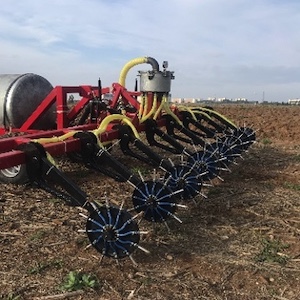
Liquid manure is a rich source of nutrients for crops, but when applied by traditional methods (broadcast) it causes loss of important nutrients such as nitrogen by evaporation and leaching simultaneously causes environmental and groundwater pollution. In this study, a high-performance liquid manure injection tool (prototype) was designed, developed and evaluated under actual field conditions. The prototype injection system consists of a prototype liquid distributor wheel that injects the liquid subsurface at certain amounts and intervals without cultivating the soil. Since the liquid manure is injected subsurface, so does not remain on the soil surface, it does not need to be mixed, and alternative to other methods in terms of nitrogen loss and availability to the plant. Laboratory and field studies were conducted to explore this system in liquid manure application. The range of slurry application rates was 4000-20000 L ha-1, at the base of system pressure and forward speed. The trials to determine efficiency of system, image analysis methods were used to quantify the percentage of the surface area covered with manure, and ammonia emission rate were determined by employing a wind tunnel and a dynamic chamber. The results showed that injecting slurry reduced NH3 emissions most effectively to 70% compared to the traditional surface spreading method. No statistically significant effect of manure application depth on ammonia emission was observed. The manure cover decreased at used by injection system. The machine demonstrated its performance by successfully injecting liquid manure into the soil and preventing nitrogen losses since the fertilizer had minimal contact with the air.
Downloads
Amberger A, Huber J, Rank M, 1987. [Gülleausbringung: Vorsicht, Ammoniakverluste].[in German]. DLG Mitteilung 102. Frankfurt, DLG e.V.
Baker CJ, Saxton KE, 2007. No-tillage seeding in conservation agriculture. Rome, FAO and CABI Publishing. DOI: https://doi.org/10.1079/9781845931162.0000
Baker JL, Colvin TS, Marley SJ, Dawelbeit ML, 1989. A point-injector applicator to improve fertilizer management. Appl Eng Agric 5:334-338. DOI: https://doi.org/10.13031/2013.26523
Cady WF, 1990. Spoked wheel fertilizer injector. U.S. Patent US 4919060A.
Department for Environment, Food and Rural Affairs, 2009. Protecting our water, soil and air: a code of good agricultural practice for farmers, growers and land managers. Available from: https://assets.publishing.service.gov.uk/media/5a7cbb27ed915d6822362336/pb13558-cogap-131223.pdf
Doorn MRJ, Natschke DF, Thorneloe SA, Southerland J, 2002. Development of an emission factor for ammonia emissions from US swine farms based on field tests and application of a mass balance method. Atmos Environ 36:5619–5625. DOI: https://doi.org/10.1016/S1352-2310(02)00689-1
FAOSTAT, 2021. FAOSTAT Online Database. Food and agriculture data. Available from: https://www.fao.org/faostat/en/#home
Hesar LG, İnce A, Ekinci K, Gücüm H, Vurarak Y, 2024. Construction and evaluation of the wind tunnel technique for estimating ammonia volatilization from land. BIO Web Conf 85:01075. DOI: https://doi.org/10.1051/bioconf/20248501075
Huijsmans JFM, De Mol RM, 1999. A model for ammonia volatilization after surface application and subsequent incorporation of manure on arable land. J Agric Eng Res 74:73-82. DOI: https://doi.org/10.1006/jaer.1999.0438
Hultgreen G, Stock W, 1999. Injecting swine manure with minimum disturbance. Proc. Workshop on Soils and Crops. Available from: https://harvest.usask.ca/server/api/core/bitstreams/508a6bb6-918c-4d25-8572-494df561a691/content
Hunt DE, Bittman S, 2021. Precision injection of dairy sludge on crop yield and N and P uptake in juvenile and mature no-till silage corn. Agronomy 11:370. DOI: https://doi.org/10.3390/agronomy11020370
Kumbul BS, 2023. Effects of different biochar applications on usable compost production in organic farming. Ph.D. Dissertation, University of Applied Sciences, Isparta.
Kushnak GD, Jackson GD, Berg RK, Carlson GR, 1992. Effect of nitrogen and nitrogen placement on no‐till small grains: plant yield relationships. Commun Soil Sci Plant Anal 23:2437-2449. DOI: https://doi.org/10.1080/00103629209368749
Lockyer DR, 1984. A system for the measurement in the field of losses of ammonia through volatilisation. J Sci Food Agric 35:837-848. DOI: https://doi.org/10.1002/jsfa.2740350805
McGinn SM, Janzen HH, 1998. Ammonia sources in agriculture and their measurement. Can J Soil Sci 78:139–148. DOI: https://doi.org/10.4141/S96-059
Meisinger JJ, Lefcourt AM, Thompson RB, 2001. Construction and validation of small mobile wind tunnels for studying ammonia volatilization. Appl Eng Agric 17:375-382. DOI: https://doi.org/10.13031/2013.6212
Özbek O, Konak M, 2017. Effect on ammonia losses of different applicators on liquid manure distribution machines. Selcuk J Agric Food Sci 31:1-10. DOI: https://doi.org/10.15316/SJAFS.2017.0
Pain BF, Phillips VR, Huijsmans JFM, 1991. Anglo-Dutch experiments on odour and ammonia emissions following the spreading of piggery wastes on arable land. IMAG Report No. 91-9.
Phillips R, 1998. Gaseous emission from the different stages of European livestock farming. In: T. Matsunaka (ed.), Proc. Int. Workshop on Environmentally Friendly Management of Farm Animal Waste; pp. 67–72.
Randall GW, Iragavarapu TK, Bock BR, 1997. Nitrogen application methods and timing for corn after soybean in a ridge‐tillage system. J Prod Agric 10:300–307. DOI: https://doi.org/10.2134/jpa1997.0300
Rodhe L, Rydberg T, Gebresenbet G, 2004. The influence of shallow injector design on ammonia emissions and draught requirement under different soil conditions. Biosyst Eng 89:237-251. DOI: https://doi.org/10.1016/j.biosystemseng.2004.07.001
Schlossberg MJ, McGraw BA, Hivner KR, Pruyne DT, 2017. Method for flux-chamber measurement of ammonia volatilization from putting greens foliarly fertilized by urea. Clean Soil Air Water 45:1700085. DOI: https://doi.org/10.1002/clen.201700085
Siemens MC, Nolte KD, Gayler RR, 2011. Improving lettuce production through utilization of spike wheel liquid injection systems. Proc. ASABE Ann. Int. Meet., Louisville, paper no. 1111245.
Smith KA, Chamber BJ, 1993. Utilizing the nitrogen content of organic manures on farms - problems and practical solutions. Soil Use Manage 9:105-111. DOI: https://doi.org/10.1111/j.1475-2743.1993.tb00938.x
Smith KA, Jackson DR, Misselbrook TH, Pain BF Johnson RA, 2000. Reduction of ammonia emission by slurry application techniques. J Agric Eng Res 773:277–287. DOI: https://doi.org/10.1006/jaer.2000.0604
Sommer SG, Sogaard HT, Møller HB, Morsing S, 2001. Ammonia volatilization from sows on grassland. Atmos. Environ. 35:2023-2032. DOI: https://doi.org/10.1016/S1352-2310(00)00428-3
Sunil BS, 2020. Development of battery electric vehicle operated weeder. Doctoral dissertation. University Dr. Panjabrao Deshmukh Krishi Vidyapeeth, Akola.
Sunil BS, 2020. Development of battery electric vehicle operated weeder. Doctoral dissertation. University Dr. Panjabrao Deshmukh Krishi Vidyapeeth, Akola.
Thompson RB, Pain BF, Lockyer DR, 1990. Ammonia volatilization from cattle slurry following surface application to grassland: I. Influence of mechanical separation, changes in chemical composition during volatilization and the presence of the grass sward. Plant Soil 125:109–117. DOI: https://doi.org/10.1007/BF00010750
Turkish Statistical Institute, 2016. Available from: http://www.tuik.gov.tr/
Vallis I, Harper LA, Catchpoole VR, Weier KL, 1982. Volatilization of ammonia from urine patches in a subtropical pasture. Aust J Agric Res 33:97-107. DOI: https://doi.org/10.1071/AR9820097
Vandré R, Kaupenjohann M, 1998. In situ measurement of ammonia emissions from organic fertilizers in plot experiments. Soil Sci Soc Am J 62:467–473. DOI: https://doi.org/10.2136/sssaj1998.03615995006200020025x
Wagner C, Nyord T, Vestergaard AV, Hafner SD, Pacholski AS, 2021. Acidification effects on in situ ammonia emissions and cereal yields depending on slurry type and application method. Agriculture 11:1053. DOI: https://doi.org/10.3390/agriculture11111053
Woodley AL, Drury CF, Reynolds WD, Calder W, Yang XM, Oloya TO, 2018. Improved acid trap methodology for determining ammonia volatilization in wind tunnel experiments. Can J Soil Sci 98:193-199. DOI: https://doi.org/10.1139/cjss-2017-0081
How to Cite

This work is licensed under a Creative Commons Attribution-NonCommercial 4.0 International License.
PAGEPress has chosen to apply the Creative Commons Attribution NonCommercial 4.0 International License (CC BY-NC 4.0) to all manuscripts to be published.