
 https://doi.org/10.4081/jae.2026.2306
Comparative study on drying kinetics and thermodynamic characteristics of Indica rice under microwave and hot-air drying
All claims expressed in this article are solely those of the authors and do not necessarily represent those of their affiliated organizations, or those of the publisher, the editors and the reviewers. Any product that may be evaluated in this article or claim that may be made by its manufacturer is not guaranteed or endorsed by the publisher.
Accepted: 15 September 2026
Published: 30 September 2026
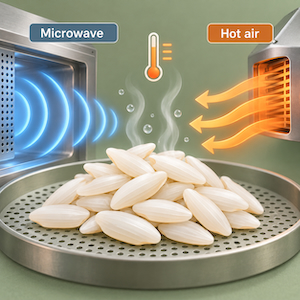
To overcome mass-transfer bottlenecks, such as case hardening, in traditional grain dehydration, this study systematically investigated the drying kinetics and thermodynamic mechanisms of Indica rice subjected to hot-air drying (HAD) and microwave drying (MD). Dehydration experiments were conducted across various operating parameters, fitted to thin-layer kinetic models, and evaluated for effective moisture diffusivity (Deff) and activation energy (Ea). The results demonstrated that the Midilli et al.’s model best predicted the drying behavior (R2>0.99). The volumetric heating inherent to microwave drying alleviated case-hardening-like resistance by inducing internal vapor pressure-driven moisture migration. To balance high dehydration efficiency with the prevention of thermal damage, a power level of 350 W and a loading mass of 40 g were identified as the optimal microwave drying conditions. Thermodynamically, HAD exhibited a V-shaped Ea trend (30.05, 15.18, and 37.63 kJ/mol) with increasing loading mass, driven by the competing effects of case hardening and macroscopic physical resistance. Conversely, MD displayed a monotonic decrease in Ea (from 35.21 to 17.04 kJ/mol), reflecting a transition toward internal pressure-driven mass transfer. Notably, MD drastically reduced the equivalent activation energy to 7.95 W/g. Under the optimal conditions (350 W, 40 g), MD reduced drying time by approximately 87.5–90.0%, increased Deff by about one order of magnitude, and achieved a higher drying-rate constant compared to HAD. In conclusion, dielectric heating effectively bypasses conventional thermal barriers, offering a thermodynamically superior and highly efficient pathway for quality-preserving industrial grain processing.
Downloads
An J, Du Y, Yan J, Xie H, Liao X, Wei H, 2024. Study on the characteristics and kinetics of microwave hot air combined drying of peanut pods. Case Stud Therm Eng 60:104640. DOI: https://doi.org/10.1016/j.csite.2024.104640
Azimi-Nejadian H, Hoseini SS, 2019. Study the effect of microwave power and slices thickness on drying characteristics of potato. Heat Mass Transfer 55:2921-2930. DOI: https://doi.org/10.1007/s00231-019-02633-x
Benseddik A, Azzi A, Zidoune MN, Khanniche R, Besombes C, 2019. Empirical and diffusion models of rehydration process of differently dried pumpkin slices. J Saudi Soc Agric Sci 18:401-410. DOI: https://doi.org/10.1016/j.jssas.2018.01.003
Calín-Sánchez Á, Lipan L, Cano-Lamadrid M, Kharaghani A, Masztalerz K, Carbonell-Barrachina ÁA, Figiel A, 2020. Comparison of traditional and novel drying techniques and its effect on quality of fruits, vegetables and aromatic herbs. Foods 9:1261. DOI: https://doi.org/10.3390/foods9091261
Dalvand MJ, Mohtasebi SS, Rafiee S, 2014. Modeling of electrohydrodynamic drying process using response surface methodology. Food Sci Nutr 2:200-209. DOI: https://doi.org/10.1002/fsn3.96
Duan G, Wu J, Que R, Zeng Y, Zeng Y, Pan X, Xie X, 2023. Agronomic and physiological performances of high-quality Indica rice under moderate and high-nitrogen conditions in Southern China. Agronomy 13:1617. DOI: https://doi.org/10.3390/agronomy13061617
Fadeyibi A, Peter AG, Adeoye AM, 2025. Design and application of radiofrequency and nanocomposite packaging for preservation of habanero pepper: effects of frequency, processing time, and film thickness. Food Biophys 20:33. DOI: https://doi.org/10.1007/s11483-024-09926-7
Fadeyibi A, Adekanye EA, Alausa YO, 2025. Enhancing preservation of kale leaves (Brassica oleracea var. acephala) using cryo-osmotic processing combined with radio frequency radiation. Eur Food Res Technol 251:4065-4077. DOI: https://doi.org/10.1007/s00217-025-04891-y
Fadeyibi A, 2023. Advances in biosensor applications for agroproducts safety. In: T. Inamuddin Altalhi (Ed.), Biosensors nanotechnology. Chichester, Wiley; pp. 469-79. DOI: https://doi.org/10.1002/9781394167135.ch20
Gana Yisa M, Fadeyibi A, Kayode Katibi K, Ucheoma OC, 2017. Performance evaluation and modification of an existing rice destoner. Int J Eng Technol 3:169-175. DOI: https://doi.org/10.19072/ijet.329078
Hao F, Yun Y, Tang J, 2012. Microwave drying of food and agricultural materials: basics and heat and mass transfer modeling. Food Eng Rev 4:89-106. DOI: https://doi.org/10.1007/s12393-012-9048-x
Hii CL, Ong SP, Yap JY, Putranto A, Mangindaan D, 2021. Hybrid drying of food and bioproducts: a review. Dry Technol 39:1554-1576. DOI: https://doi.org/10.1080/07373937.2021.1914078
Huang D, Men K, Tang X, Li W, Sherif SA, 2020. Microwave intermittent drying characteristics of camellia oleifera seeds. J Food Process Eng 44:e13608. DOI: https://doi.org/10.1111/jfpe.13608
Huang J, Zhang M, 2016. Effect of three drying methods on the drying characteristics and quality of okra. Dry Technol 34:900-911. DOI: https://doi.org/10.1080/07373937.2015.1086367
Imaizumi T, Orikasa T, Morifusa S, Man LV, Muramatsu Y, Koide S, Tagawa A, 2015. Effects of solution spraying during hot-air drying on drying rate, case hardening and browning of fresh-cut Japanese pear. Eng Agric Environ Food 8:1-6. DOI: https://doi.org/10.1016/j.eaef.2015.01.001
Keshavalu, Panda BK, Khan S, Nagvanshi S, Shrivastava SL, 2017. Kinetics of parboiled paddy under microwave drying. Curr J Appl Sci Technol 22:1-11. DOI: https://doi.org/10.9734/CJAST/2017/32841
Lewicki PP, 2006. Design of hot-air drying for better foods. Trends Food Sci Technol 17:153-163. DOI: https://doi.org/10.1016/j.tifs.2005.10.012
Li K, Zhang Y, Wang YF, El-Kolaly W, Gao M, Sun W, Li M, 2021. Effects of drying variables on the characteristic of the hot-air drying for gastrodia elata: Experiments and multi-variable model. Energy 222:119982. DOI: https://doi.org/10.1016/j.energy.2021.119982
Ling F, Sun T, 2021. Study on the drying characteristics of rice by microwave and hot air drying. J Eng 2021:201-208. https://doi.org/10.1049/tje2.12027 DOI: https://doi.org/10.1049/tje2.12027
Luthra K, Sadaka S, Atungulu G, 2021. Effects of ambient air dehumidification, air temperature, and drying duration on rough rice quality and pasting properties using fluidized bed and fixed bed dryers. Cereal Chemistry 98:968-979. DOI: https://doi.org/10.1002/cche.10438
Namjoo M, Golbakhshi H, Kamandar MR, Beigi M, 2024. Multi-objective investigation and optimization of paddy processing in a hot air dryer. Period Polytech-Chem 68:529-540. DOI: https://doi.org/10.3311/PPch.24100
National Bureau of Statistics, 2025. Announcement of the National Bureau of Statistics on early rice yield data in 2025. China Statistics Press, Beijing. Available from: https://www.chinagrowtech.com/cnt_884.html
Okunola AA, Adekanye TA, Okonkwo CE, Kaveh M, Szymanek M, Idahosa EO, Olayanju AT, Wojciechowska K, 2023. Drying characteristics, kinetic modeling, energy and exergy analyses of water yam (Dioscorea alata) in a hot air dryer. Energies 16:1569. DOI: https://doi.org/10.3390/en16041569
Sağlam C, Çetin N, 2022. Machine learning algorithms to estimate drying characteristics of apples slices dried with different methods. J Food Process Preserv 46:e16496. DOI: https://doi.org/10.1111/jfpp.16496
Sharma GP, Prasad S, 2001. Drying of garlic (Allium sativum) cloves by microwave–hot air combination. J Food Eng 50:99-105. DOI: https://doi.org/10.1016/S0260-8774(00)00200-4
Shen L, Zhu Y, Liu C, Wang L, Liu H, Kamruzzaman M, Zheng X, 2020. Modelling of moving drying process and analysis of drying characteristics for germinated brown rice under continuous microwave drying. Biosyst Eng 195:64-88. DOI: https://doi.org/10.1016/j.biosystemseng.2020.05.002
Shewale SR, Rajoriya DH, Hebbar U, 2019. Low humidity air drying of apple slices: Effect of EMR pretreatment on mass transfer parameters, energy efficiency and quality. Innov Food Sci Emerg Technol 55:1-10. DOI: https://doi.org/10.1016/j.ifset.2019.05.006
Soponronnarit S, Nathakaranakule A, Jirajindalert A, Taechapairoj C, 2001. Effect of drying air temperature and grain temperature of different types of dryer and operation on rice quality. Dry Technol 19:389-404. DOI: https://doi.org/10.1081/DRT-100102912
Szopińska D, Dorna H, 2021. The effect of microwave treatment on germination and health of carrot (Daucus carota L.) seeds. Agronomy 11:2571. DOI: https://doi.org/10.3390/agronomy11122571
Silva EG, Gomez RS, Gomes JP, Silva WP, Porto KYN, Rolim FD, et al., 2021. Heat and mass transfer on the microwave drying of rough rice grains: an experimental analysis. Agriculture 11:8. DOI: https://doi.org/10.3390/agriculture11010008
Xia X, Jin Y, Zhao H, Wang G, Huang D, 2023. Optimization and experiment of hot-air drying process of Cyperus esculentus seeds. Agriculture 13:617. DOI: https://doi.org/10.3390/agriculture13030617
Xu X, Zhao T, Ma J, Song Q, Wei Q, Sun W, 2022. Application of two-stage variable temperature drying in hot air-drying of paddy rice. Foods 11:888. DOI: https://doi.org/10.3390/foods11060888
CRediT authorship contribution
All the authors made a substantive intellectual contribution, read and approved the final version of the manuscript and agreed to be accountable for all aspects of the work.
Data Availability Statement
All data generated or analyzed during this study are included in this published article.
How to Cite

This work is licensed under a Creative Commons Attribution-NonCommercial 4.0 International License.
PAGEPress has chosen to apply the Creative Commons Attribution NonCommercial 4.0 International License (CC BY-NC 4.0) to all manuscripts to be published.