
 https://doi.org/10.4081/jae.2026.2231
Leveraging technology, renewable energy and digital tools for environmentally sustainable dairy production: a case study
All claims expressed in this article are solely those of the authors and do not necessarily represent those of their affiliated organizations, or those of the publisher, the editors and the reviewers. Any product that may be evaluated in this article or claim that may be made by its manufacturer is not guaranteed or endorsed by the publisher.
Accepted: 25 August 2026
Published: 9 September 2026
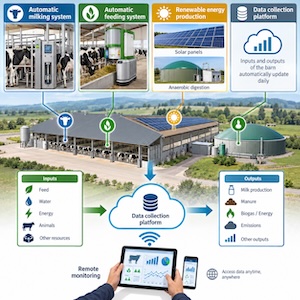
The environmental sustainability of livestock production is a well-researched topic. Although there are various ways to reduce the environmental impact of producing milk and meat from dairy cows, enteric methane emissions remain a significant and unavoidable factor. However, improvements in efficiency, greater attention to animal health and welfare, and renewable energy production initiatives can help farmers minimise their environmental footprint. In this context, technology and farm digitalisation can support farmers in managing their farms. This study aims to analyse the environmental performance of a dairy cattle farm in an intensive livestock area in northern Italy using Life Cycle Assessment (LCA). The farm has automatic milking and feeding systems, as well as renewable energy production plants (solar panels and anaerobic digestion), all of which can be monitored remotely. Through an external enterprise, a data collection platform was developed with inputs and outputs of the barn that automatically update daily. To each input/output, a value of carbon footprint was matched, resulting in a daily carbon footprint calculator of the farm, for the whole year 2024. The results of the LCA study show a remarkably low environmental impact, with a carbon footprint of 0.80 kg CO₂eq/kg fat- and protein-corrected milk (FPCM). Instead, the daily carbon footprint calculator consistently yielded lower estimates because of its simplified methodology. However, its purpose is not to replace comprehensive emission assessments but to provide a simple and easily generated indicator that helps increase farmers' awareness of the environmental impacts associated with their daily farming practices.
Downloads
Bacenetti J, Lovarelli D, Fiala M, 2016. Mechanisation of organic fertiliser spreading, choice of fertiliser and crop residue management as solutions for maize environmental impact mitigation. Eur J Agron 79:107-118. DOI: https://doi.org/10.1016/j.eja.2016.05.015
Balaine L, Dillon EJ, Läpple D, Lynch J, 2020. Can technology help achieve sustainable intensification? Evidence from milk recording on Irish dairy farms. Land Use Policy 92:104437. DOI: https://doi.org/10.1016/j.landusepol.2019.104437
Baldini C, Gardoni D, Guarino M, 2017. A critical review of the recent evolution of Life Cycle Assessment applied to milk production. J Clean Prod 140:421-435. DOI: https://doi.org/10.1016/j.jclepro.2016.06.078
Battini F, Agostini A, Boulamanti AK, Giuntoli J, Amaducci S, 2014. Mitigating the environmental impacts of milk production via anaerobic digestion of manure: Case study of a dairy farm in the Po Valley. Sci Total Environ 481:196-208 DOI: https://doi.org/10.1016/j.scitotenv.2014.02.038
Berckmans D, 2017. General introduction to precision livestock farming. Anim Front 7:6-11. DOI: https://doi.org/10.2527/af.2017.0102
Berton M, Bittante G, Sturaro E, Gallo L, 2024. Thirty years of global warming potential evolution for the Italian dairy cow sector measured by two different metrics. Ital J Anim Sci 23:1002-1017. DOI: https://doi.org/10.1080/1828051X.2024.2373211
Bianchi MC, Bava L, Sandrucci A, Tangorra FM, Tamburini A, Gislon G, Zucali M, 2022. Diffusion of precision livestock farming technologies in dairy cattle farms. Animal 16:100650. DOI: https://doi.org/10.1016/j.animal.2022.100650
Correddu F, Lunesu MF, Sechi S, Caratzu MF, Pulina G, 2025. CO2 removal to reach net zero warming of global methane and nitrous oxide emissions of livestock: Comparison of two metrics under different 2050 FAO scenarios. PLoS One 20:e0330379. DOI: https://doi.org/10.1371/journal.pone.0330379
de Vries W, 2021. Impacts of nitrogen emissions on ecosystems and human health: A mini review. Curr Opin Env Sci Hl 21:100249 DOI: https://doi.org/10.1016/j.coesh.2021.100249
Džermeikaitė K, Bačėninaitė D, Antanaitis R, 2023. Innovations in cattle farming: application of innovative technologies and sensors in the diagnosis of diseases. Animals (Basel) 13:780. DOI: https://doi.org/10.3390/ani13050780
EDA, 2025. Product Environmental Footprint Category Rules for Dairy Products. pp: 1-180. Available from: https://eda.euromilk.org/wp-content/uploads/2025/02/PEFCR-DairyProducts_update_final.pdf
EMEP/EEA, 2019. Air pollutant emission inventory guidebook 2019-Wastewater handling 2019. Available from: https://www.eea.europa.eu/en/analysis/publications/emep-eea-guidebook-2019
Espinosa-Marrón A, Adams K, Sinno L, Cantu-Aldana A, Tamez M, Marrero A, et al., 2022. Environmental impact of animal-based food production and the feasibility of a shift toward sustainable plant-based diets in the United States. Front Sustain 3:841106. DOI: https://doi.org/10.3389/frsus.2022.841106
Evangelista C, Milanesi M, Pietrucci D, Chillemi G, Bernabucci U, 2024. Enteric methane emission in livestock sector: bibliometric research from 1986 to 2024 with text mining and topic analysis approach by machine learning algorithms. Animals (Basel) 14:3158. DOI: https://doi.org/10.3390/ani14213158
Finger R, 2023. Digital innovations for sustainable and resilient agricultural systems. Eur Rev Agric Econ 50:1277-1309. DOI: https://doi.org/10.1093/erae/jbad021
Finzi A, Riva E, Bicoku A, Guido V, Shallari S, Provolo G, 2019. Comparison of techniques for ammonia emission mitigation during storage of livestock manure and assessment of their effect in the management chain. J Agr Eng 50:881. DOI: https://doi.org/10.4081/jae.2019.881
Froldi F, Lamastra L, Trevisan M, Mambretti D, Moschini M, 2022. Environmental impacts of cow’s milk in Northern Italy: Effects of farming performance. J Clean Prod 363:132600. DOI: https://doi.org/10.1016/j.jclepro.2022.132600
Gorton M, Yeh CH, Chatzopoulou E, White J, Tocco B, Hubbard C, Hallam F, 2023. Consumers’ willingness to pay for an animal welfare food label. Ecol Econ 209:107852. DOI: https://doi.org/10.1016/j.ecolecon.2023.107852
Halachmi I, Guarino M, Bewley J, Pastell M, 2019. Smart animal agriculture: application of real-time sensors to improve animal well-being and production. Annu Rev Anim Biosci 7:403-425. DOI: https://doi.org/10.1146/annurev-animal-020518-114851
International Dairy Federation (IDF), 2015. A common carbon footprint approach for dairy. The IDF guide to standard lifecycle assessment methodology for the dairy sector. Bulletin IDF No 479/2010. Brussels, International Dairy Federation.
IPCC, 2019. Emissions from livestock and manure management. Available from: https://www.ipcc-nggip.iges.or.jp/public/2019rf/pdf/4_Volume4/19R_V4_Ch10_Livestock.pdf
ISO 14040, 2006. Environmental Management — Life cycle assessment — Requirements and Guidelines. Geneva, International Organization for Standardization.
ISO 14044, 2018. Environmental Management — Life Cycle Assessment — Principles and Framework. Geneva, International Organization for Standardization.
Jacobs JA, Siegford JM, 2012. Invited review: The impact of automatic milking systems on dairy cow management, behavior, health, and welfare. J Dairy Sci 95:2227-2247. DOI: https://doi.org/10.3168/jds.2011-4943
Kupper T, Häni C, Neftel A, Kincaid C, Bühler M, Amon B, VanderZaag A, 2020. Ammonia and greenhouse gas emissions from slurry storage - A review. Agric Ecosyst Environ 300:106963. DOI: https://doi.org/10.1016/j.agee.2020.106963
Lamanna M, Muca E, Montano C, Bovo M, Petretto F, Colleluori R, et al., 2026. Smart enough? What Italian farmers reveal about dairy cow technologies: a survey study. Animals (Basel) 16:1170. DOI: https://doi.org/10.3390/ani16081170
Leliveld LMC, Brandolese C, Grotto M, Marinucci A, Fossati N, Lovarelli D, et al., 2024. Real-time automatic integrated monitoring of barn environment and dairy cattle behaviour: Technical implementation and evaluation on three commercial farms. Comput Electron Agr 216:108499 DOI: https://doi.org/10.1016/j.compag.2023.108499
Lorenz H, Reinsch T, Hess S, Taube F, 2019. Is low-input dairy farming more climate friendly? A meta-analysis of the carbon footprints of different production systems. J Clean Prod 211:161-170. DOI: https://doi.org/10.1016/j.jclepro.2018.11.113
Lovarelli D, Bacenetti J, 2017. Seedbed preparation for arable crops: Environmental impact of alternative mechanical solutions. Soil Till Res 174:156-168. DOI: https://doi.org/10.1016/j.still.2017.06.006
Lovarelli D, Bava L, Zucali M, D’Imporzano G, Adani F, Tamburini A, Sandrucci A, 2019. Improvements to dairy farms for environmental sustainability in Grana Padano and Parmigiano Reggiano production systems. Ital J Anim Sci 18:1035-1048. DOI: https://doi.org/10.1080/1828051X.2019.1611389
Lovarelli D, Bovo M, Giannone C, Santolini E, Tassinari P, Guarino M, 2024. Reducing life cycle environmental impacts of milk production through precision livestock farming. Sustain Prod Consum 51:303-314. DOI: https://doi.org/10.1016/j.spc.2024.09.021
Manono BO, 2026. Methane emissions from livestock operations: Sources, sinks, and mitigation strategies. Methane 5:7. DOI: https://doi.org/10.3390/methane5010007
Mazzetto AM, Falconer S, Ledgard S, 2022. Mapping the carbon footprint of milk production from cattle: A systematic review. J Dairy Sci 105:9713-9725. DOI: https://doi.org/10.3168/jds.2022-22117
Melgar A, Lage CFA, Nedelkov K, Räisänen SE, Stefenoni H, Fetter ME, et al., 2021. Enteric methane emission, milk production, and composition of dairy cows fed 3-nitrooxypropanol. J. Dairy Sci 104:357-366. DOI: https://doi.org/10.3168/jds.2020-18908
Papadopoulos G, Papantonatou MZ, Uyar H, Kriezi O, Mavrommatis A, Psiroukis V, et al., 2025. Economic and environmental benefits of digital agricultural technological solutions in livestock farming: A review. Smart Agric Technol 10:100783. DOI: https://doi.org/10.1016/j.atech.2025.100783
Polsky L, von Keyserlingk MAG, 2017. Invited review: Effects of heat stress on dairy cattle welfare. J Dairy Sci 100:8645-8657. DOI: https://doi.org/10.3168/jds.2017-12651
Pulina G, Lunesu MF, Pirlo G, Ellies-Oury MP, Chriki S, Hocquette JF, 2022. Sustainable production and consumption of animal products. Curr Opin Env Sci Hl 30:100404. DOI: https://doi.org/10.1016/j.coesh.2022.100404
Rencricca G, Froldi F, Moschini M, Trevisan M, Lamastra L, 2023. Mitigation actions scenarios applied to the dairy farm management systems. Foods 12:1860. DOI: https://doi.org/10.3390/foods12091860
Riaboff L, Shalloo L, Smeaton AF, Couvreur S, Madouasse A, Keane MT, 2022. Predicting livestock behaviour using accelerometers: A systematic review of processing techniques for ruminant behaviour prediction from raw accelerometer data. Comput Electron Agr 192:106610. DOI: https://doi.org/10.1016/j.compag.2021.106610
Spizzirri UG, Notarnicola B, De Molfetta M, Renzulli PA, Astuto F, Lovarelli D, et al., 2026. Direct measurement of methane emissions in cattle breeds by using UAV monitoring systems to improve data quality in LCA. Int J Life Cycle Assess 31:20. DOI: https://doi.org/10.1007/s11367-026-02620-5
Tullo E, Finzi A, Guarino M, 2019. Review: Environmental impact of livestock farming and Precision Livestock Farming as a mitigation strategy. Sci Total Environ 650:2751-2760. DOI: https://doi.org/10.1016/j.scitotenv.2018.10.018
Udo HMJ, Aklilu HA, Phong LT, Bosma RH, Budisatria IGS, Patil BR, et al., 2011. Impact of intensification of different types of livestock production in smallholder crop-livestock systems. Livest Sci 139:22-29. DOI: https://doi.org/10.1016/j.livsci.2011.03.020
Vigo F, Zoli M, Lovarelli D, Bacenetti J, 2025. Environmental impact assessment of maize cultivation system considering different irrigation methods. J Agr Eng 56:1663. DOI: https://doi.org/10.4081/jae.2025.1663
West JW, 2003. Effects of heat-stress on production in dairy cattle. J Dairy Sci 86:2131-2144. DOI: https://doi.org/10.3168/jds.S0022-0302(03)73803-X
CRediT authorship contribution
Daniela Lovarelli, conceptualization, data curation, formal analysis, investigation, methodology, visualization, writing - original draft, writing - review & editing. Rosa Martecchini, writing – review & editing. Marcella Guarino, conceptualization, supervision, writing - review & editing.
Data Availability Statement
The datasets used and/or analyzed during the current study are available upon reasonable request from the corresponding author.
How to Cite

This work is licensed under a Creative Commons Attribution-NonCommercial 4.0 International License.
PAGEPress has chosen to apply the Creative Commons Attribution NonCommercial 4.0 International License (CC BY-NC 4.0) to all manuscripts to be published.