

 https://doi.org/10.4081/jae.2026.2199
Field-based implementation of machine learning forecasting for energy-efficient temperature control in a greenhouse system
All claims expressed in this article are solely those of the authors and do not necessarily represent those of their affiliated organizations, or those of the publisher, the editors and the reviewers. Any product that may be evaluated in this article or claim that may be made by its manufacturer is not guaranteed or endorsed by the publisher.
Accepted: 25 May 2026
Published: 5 June 2026
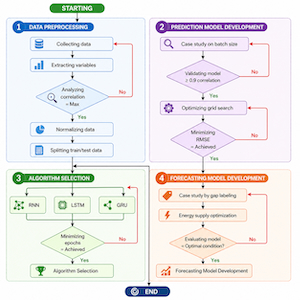
In this study, we developed a simulation model for the internal environment of greenhouses using artificial intelligence techniques. This study focuses on the practical application of machine learning (ML)-based forecasting for greenhouse temperature control and its potential to improve energy efficiency under real-world operating conditions. This study was conducted to optimize energy consumption through smart agriculture applications. A prediction model was established using a time-series ML approach, followed by the development of forecasting models through gap-labeling feature analysis. Data were collected from a greenhouse equipped with a pellet boiler-based heating system over 55 d under real operating conditions. Iterative learning was conducted using 7 d of training data and 1 d of validation data, resulting in 48 models (average r2 = 0.77, RMSE = 1.43). Based on the forecasting results, a data-driven control strategy was applied to adjust the heating operation in advance. The reduction in heating operation time demonstrates improved energy efficiency of the greenhouse system under practical operating conditions by minimizing unnecessary heating. Implementing data-driven predictive control using the developed forecasting model can save 5 %–15% of the energy. Statistical analysis using the Wilcoxon signed-rank test indicated that the performance differences among the models were not statistically significant (p > 0.05). Therefore, this study emphasizes the practical implementation of machine learning-based forecasting for real-time greenhouse control under actual operating conditions.
Downloads
References
Abasilim C, Friedman LS, Martin MC, Madigan D, Perez J, Morera M, et al., 2024. Risk factors associated with indicators of dehydration among migrant farmworkers. Environ Res 251:118633. DOI: https://doi.org/10.1016/j.envres.2024.118633
Aggarwal CC, 2018. Neural networks and deep learning: a textbook. Cham, Springer. DOI: https://doi.org/10.1007/978-3-319-94463-0
Ariga M, Nakayama S, Nishibayasi D, 2018. Machine learning at work. Sebastopol, O’Reilly Media.
Cemek B, Atiş A, Küçüktopçu E, 2017. Evaluation of temperature distribution in different greenhouse models using computational fluid dynamics (CFD). J Agric Sci 32:54-54. DOI: https://doi.org/10.7161/omuanajas.289354
Chang Z, Zhang Y, Chen W, 2019. Electricity price prediction based on hybrid model of adam optimized LSTM neural network and wavelet transform. Energy 187:115804. DOI: https://doi.org/10.1016/j.energy.2019.07.134
Chen J, Xu F, Tan D, Shen Z, Zhang L, Ai Q, 2015. A control method for agricultural greenhouses heating based on computational fluid dynamics and energy prediction model. Appl Energy 141:106-118. DOI: https://doi.org/10.1016/j.apenergy.2014.12.026
Choi W, Lee S, 2023. Performance evaluation of deep learning architectures for load and temperature forecasting under dataset size constraints and seasonality. Energy Build 288:113027. DOI: https://doi.org/10.1016/j.enbuild.2023.113027
Choi YS, Lee HJ, Joung ST, 2012. A design and implementation of web-based green house automation system. J Korea Inst Electron Commun Sci 7:1519-1527.
da Rosa Righi R, Goldschmidt G, Kunst R, Deon C, da Costa CA, 2020. Towards combining data prediction and internet of things to manage milk production on dairy cows. Comput Electron Agric 169:105156. DOI: https://doi.org/10.1016/j.compag.2019.105156
Dahl M, Brun A, Andresen GB, 2017. Using ensemble weather predictions in district heating operation and load forecasting. Appl Energy 193:455-465. DOI: https://doi.org/10.1016/j.apenergy.2017.02.066
Deng Z, Wang X, Jiang Z, Zhou N, Ge H, Dong B, 2023. Evaluation of deploying data-driven predictive controls in buildings on a large scale for greenhouse gas emission reduction. Energy 270:126934. DOI: https://doi.org/10.1016/j.energy.2023.126934
François C, 2017. Deep learning with Python. Shelter Island, Manning Publications.
Frausto HU, Pieters JG, Deltour JM, 2003. Modelling greenhouse temperature by means of auto regressive models. Biosyst Eng 84:147-157. DOI: https://doi.org/10.1016/S1537-5110(02)00239-8
Graves A, 2012. Long short-term memory. In: Supervised sequence labelling with recurrent neural networks. Berlin, Springer pp. 37-45. DOI: https://doi.org/10.1007/978-3-642-24797-2_4
Guzmán CH, Carrera JL, Durán HA, Berumen J, Ortiz AA, Guirette OA, et al., 2019. Implementation of virtual sensors for monitoring temperature in greenhouses using CFD and control. Sensors (Basel) 19:60. DOI: https://doi.org/10.3390/s19010060
He Z, Jiang T, Jiang Y, Luo Q, Chen S, Gong K, et al., 2022. Gated recurrent unit models outperform other machine learning models in prediction of minimum temperature in greenhouse based on local weather data. Comput Electron Agric 202:107416. DOI: https://doi.org/10.1016/j.compag.2022.107416
Hochreiter S, Schmidhuber J, 1997. Long short-term memory. Neural Comput 9:1735-1780. DOI: https://doi.org/10.1162/neco.1997.9.8.1735
Huh M-H, 2017. Representing variables in the latent space. Korean J Appl Stat 30:555-566. DOI: https://doi.org/10.5351/KJAS.2017.30.4.555
Jung D-H, Kim HS, Jhin C, Kim H-J, Park SH, 2020. Time-serial analysis of deep neural network models for prediction of climatic conditions inside a greenhouse. Comput Electron Agric 173:105402. DOI: https://doi.org/10.1016/j.compag.2020.105402
Kadlec P, Gabrys B, 2009. Soft sensors: where are we and what are the current and future challenges? IFAC Proc 42:572-577. DOI: https://doi.org/10.3182/20090921-3-TR-3005.00098
Kim R-W, Hong S-W, Lee I-B, Kwon K-S, 2017. Evaluation of wind pressure acting on multi-span greenhouses using CFD technique, Part 2: Application of the CFD model. Biosyst Eng 164:257-280. DOI: https://doi.org/10.1016/j.biosystemseng.2017.09.011
Kumari P, Toshniwal D, 2021. Long short term memory–convolutional neural network based deep hybrid approach for solar irradiance forecasting. Appl Energy 295:117061. DOI: https://doi.org/10.1016/j.apenergy.2021.117061
Kwon H, Oh KC, Choi Y, Chung YG, Kim J, 2021. Development and application of machine learning‐based prediction model for distillation column. Int J Intell Syst 36:1970-1997. DOI: https://doi.org/10.1002/int.22368
Lederrey G, Lurkin V, Hillel T, Bierlaire M, 2021. Estimation of discrete choice models with hybrid stochastic adaptive batch size algorithms. J Choice Modell 38:100226. DOI: https://doi.org/10.1016/j.jocm.2020.100226
Lee D, Ooka R, Matsuda Y, Ikeda S, Choi W, 2022. Experimental analysis of artificial intelligence-based model predictive control for thermal energy storage under different cooling load conditions. Sustain Cities Soc 79:103700. DOI: https://doi.org/10.1016/j.scs.2022.103700
Liu G, Zhong K, Li H, Chen T, Wang Y, 2024. A state of art review on time series forecasting with machine learning for environmental parameters in agricultural greenhouses. Inf Process Agric 11:143-162. DOI: https://doi.org/10.1016/j.inpa.2022.10.005
López Santos M, Díaz García S, García-Santiago X, Ogando-Martínez A, Echevarría Camarero F, Blázquez Gil G, Carrasco Ortega P, 2023. Deep learning and transfer learning techniques applied to short-term load forecasting of data-poor buildings in local energy communities. Energy Build 292:113164. DOI: https://doi.org/10.1016/j.enbuild.2023.113164
Lv W, Shen C, Li X, 2018. Energy efficiency of an air conditioning system coupled with a pipe-embedded wall and mechanical ventilation. J Build Eng 15:229-235. DOI: https://doi.org/10.1016/j.jobe.2017.11.010
Muller AC, Guido S, 2017. Introduction to machine learning with Python: a guide for data scientists. Sebastopol, O’Reilly Media.
Oh KC, Kim SJ, Park SY, Lee CG, Cho LH, Jeon YK, Kim DH, 2022. Development and verification of smart greenhouse internal temperature prediction model using machine learning algorithm. J Bio-Env Con31:152-162. DOI: https://doi.org/10.12791/KSBEC.2022.31.3.152
Oh KC, Park SY, Kim SJ, Choi YS, Lee CG, Cho LH, Kim DH, 2019. Development and validation of mass reduction model to optimize torrefaction for agricultural byproduct biomass. Renew Energy 139:988-999. DOI: https://doi.org/10.1016/j.renene.2019.02.106
Oh KC, Park SY, Kim SJ, Cho LH, Lee CG, Kim DH, 2024a. Development of a greenhouse environmental forecasting model using machine learning to optimize energy consumption. Available from: https://ssrn.com/abstract=4975488 DOI: https://doi.org/10.2139/ssrn.4975488
Oh KC, Kwon H, Park SY, Kim SJ, Kim J, Kim D, 2024b. Hyperparameter optimization of the machine learning model for distillation processes. Int J Intell Syst 2024:5564380. DOI: https://doi.org/10.1155/2024/5564380
Outanoute M, Lachhab A, Ed-Dahhak A, Selmani A, Guerbaoui M, Bouchikhi B, 2015. A neural network dynamic model for temperature and relative humidity control under greenhouse. Proc. Third Int. Workshop on RFID and Adaptive Wireless Sensor Networks (RAWSN), Agadir; pp. 6-11. DOI: https://doi.org/10.1109/RAWSN.2015.7173270
Pardey PG, Beddow JM, Hurley TM, Beatty TKM, Eidman VR, 2014. A bounds analysis of world food futures: global agriculture through to 2050. Aus J Agri Res Econ 58:571-589. DOI: https://doi.org/10.1111/1467-8489.12072
Runge J, Saloux E, 2023. A comparison of prediction and forecasting artificial intelligence models to estimate the future energy demand in a district heating system. Energy 269:126661. DOI: https://doi.org/10.1016/j.energy.2023.126661
Runge J, Zmeureanu R, 2019. Forecasting energy use in buildings using artificial neural networks: a review. Energies 12:3254. DOI: https://doi.org/10.3390/en12173254
Serale G, Fiorentini M, Capozzoli A, Bernardini D, Bemporad A, 2018. Model predictive control (MPC) for enhancing building and HVAC system energy efficiency: problem formulation, applications and opportunities. Energies 11:631. DOI: https://doi.org/10.3390/en11030631
Smith SL, Kindermans PJ, Ying C, Le QV, 2017. Don’t decay the learning rate, increase the batch size. arXiv:1711.00489.
Song J, Zhang L, Xue G, Ma Y, Gao S, Jiang Q, 2021. Predicting hourly heating load in a district heating system based on a hybrid CNN-LSTM model. Energy Build 243:110998. DOI: https://doi.org/10.1016/j.enbuild.2021.110998
Venkateswaran D, Cho Y, 2024. Efficient solar power generation forecasting for greenhouses: a hybrid deep learning approach. Alex Eng J 91:222-236. DOI: https://doi.org/10.1016/j.aej.2024.02.004
Wang H, Asefa T, Duncan J, 2024. Event-based evaluation of operational ENSO forecasting models in 2002–2020: implications for seasonal water resources management. J Hydrol 636:131295. DOI: https://doi.org/10.1016/j.jhydrol.2024.131295
Wang Y, Duan X, Zou R, Zhang F, Li Y, Hu Q, 2023. A novel data-driven deep learning approach for wind turbine power curve modeling. Energy 270:126908. DOI: https://doi.org/10.1016/j.energy.2023.126908
Wang T, Mehdi QH, Gough NE, Griffiths IJ, 1997. A hybrid intelligent controller based on “consultation of doctors”. IFAC Proc 30:457-462. DOI: https://doi.org/10.1016/S1474-6670(17)43307-6
Wei X, Liu Y, Gao S, Wang X, Yue H, 2019. An RNN-based delay-guaranteed monitoring framework in underwater wireless sensor networks. IEEE Access 7:25959-25971. DOI: https://doi.org/10.1109/ACCESS.2019.2899916
Wu Y, Gao Y, Wang C, Chen Q, Ming T, 2023. The energy saving performance of the thermal diode composite wall in different climate regions. Renew Energy 219:119360. DOI: https://doi.org/10.1016/j.renene.2023.119360
Yao Y, Shekhar DK, 2021. State of the art review on model predictive control (MPC) in heating ventilation and air-conditioning (HVAC) field. Build Environ 200:107952. DOI: https://doi.org/10.1016/j.buildenv.2021.107952
Zhang Y, Meng F, Wang R, Zhu W, Zeng XJ, 2018. A stochastic MPC based approach to integrated energy management in microgrids. Sustain Cities Soc 41:349-362. DOI: https://doi.org/10.1016/j.scs.2018.05.044
CRediT authorship contribution
Sunyong Park, conceptualization, data curation, and writing—original draft; Dae Hyun Kim, methodology development, model implementation, and formal analysis; Kwang Cheol Oh, supervision, research design, validation, project administration, and writing—review and editing. All authors read and approved the final version of the manuscript and agreed to be accountable for all aspects of the work.
Supporting Agencies
Data Availability Statement
The datasets used or analyzed during the current study are available from the corresponding author on reasonable request.
How to Cite

This work is licensed under a Creative Commons Attribution-NonCommercial 4.0 International License.
PAGEPress has chosen to apply the Creative Commons Attribution NonCommercial 4.0 International License (CC BY-NC 4.0) to all manuscripts to be published.