

 https://doi.org/10.4081/jae.2026.2146
Optimization of energy use and torque in vertical axis rotary tillers: effects of disc diameter and blade number on tillage performance
All claims expressed in this article are solely those of the authors and do not necessarily represent those of their affiliated organizations, or those of the publisher, the editors and the reviewers. Any product that may be evaluated in this article or claim that may be made by its manufacturer is not guaranteed or endorsed by the publisher.
Accepted: 14 July 2026
Published: 28 July 2026
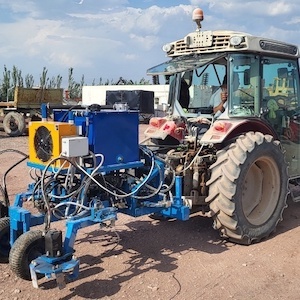
Efficient soil management in vineyards with stony, loamy–sand soils is crucial for energy conservation and sustainable production, particularly in organic systems where herbicide use is restricted. Rotary tillers with vertical axes are widely used for intra-row and near-trunk tillage but are often limited by high energy demand. This study aimed to develop a mathematical model to optimize the operating regime of rotary tillers by evaluating the relationship between torque resistance, which is the key energy indicator, and primary kinematic parameters: disc rotational speed and diameter. Field experiments were conducted at the Voskehat Experimental Station in Armenia using a two-factor, second-order central composite design. Torque was measured with a high-precision strain-gauge system, and two groups of L-shaped blades (Z₁ = 3 and Z₂ = 4) were tested. Regression analysis showed that disc diameter had a strong linear effect on torque, while rotational speed exhibited a weaker influence that varied with blade number. In all cases, torque variation did not exceed 10 N·m within the speed range of 16.5–20.5 s-1. Distinct functional patterns of torque variation were observed depending on blade number, likely reflecting the interaction between soil deformation wave propagation and disc rotation. Defining the optimal operating regime, therefore, requires minimizing torque while ensuring that the kinematic parameters satisfy agrotechnical requirements, thereby preventing excessive soil pulverization, reducing erosion risk, and ensuring high-quality tillage.
Downloads
Abo-Habaga M, Imara Z, Okasha M, 2018. Development of a combine hoeing machine for flat and ridged. J Soil Sci Agric Eng 9:817-820. DOI: https://doi.org/10.21608/jssae.2018.36548
Abu-Hamdeh NH, 2000. Effect of tillage treatments on soil thermal conductivity for some Jordanian clay loam and loam soils. Soil Till Res 56:145-151. DOI: https://doi.org/10.1016/S0167-1987(00)00129-X
Ahmadi I. 2017. A power estimator for an integrated active-passive tillage machine using the laws of classical mechanics. Soil Till Res 171:1-8. DOI: https://doi.org/10.1016/j.still.2017.04.006
Bernacki H, 1962. [Theory of Tillers].[Article in Polish]. Warsaw, Institute of Agricultural Mechanization and Electrification.
Bhandral R, Saggar S, Bolan NS, Hedley MJ, 2007. Transformation of nitrogen and nitrous oxide emission from grassland soils as affected by compaction. Soil Till Res 94:482-492. DOI: https://doi.org/10.1016/j.still.2006.10.006
Czyź EA, 2004. Effect of traffic on soil aeration, bulk density and growth of barley. Soil Till Res 79:153-166. DOI: https://doi.org/10.1016/j.still.2004.07.004
Damanauskas V, Janulevičius A, 2022. Effect of tillage implement (spring tine cultivator, disc harrow), soil texture, forward speed, and tillage depth on fuel consumption and tillage quality. J Agric Eng 53:1371. DOI: https://doi.org/10.4081/jae.2022.1371
Faber F, Wachter E, Zaller JG, 2017. Earthworms are little affected by reduced soil tillage methods in vineyards. Plant Soil Environ 63:257-263. DOI: https://doi.org/10.17221/160/2017-PSE
Ferrero A, Usowicz B, Lipiec J, 2005. Effects of tractor traffic on spatial variability of soil strength and water content in grass covered and cultivated sloping vineyard. Soil Till Res 84:127-138. DOI: https://doi.org/10.1016/j.still.2004.10.003
Grigoryan AS, Altunyan AV, 2021. [The effect of some factors on the cutting angle of the vertical blade during rotary soil tillage].[Article in Armenian with English abstract]. AgriSci Technol 75:230-23.4
He C, Han G, Ye T, Wei M, Sun C, Cheng Y, 2025. Design and evaluation of a new deep vertical rotary tiller for enhanced field performance. INMATEH Agric Eng 76:746-756. DOI: https://doi.org/10.35633/inmateh-76-63
Hegazy RA, Abdelmotaleb IA, Imara ZM, Okasha MH, 2014. Development and evaluation of small-scale power weeder. Misr J Agric Eng 31:703-728. DOI: https://doi.org/10.21608/mjae.2014.98430
International Organisation of Vine and Wine, 2024. State of the World Vine and Wine Sector in 2024. Available from: https://www.oiv.int/sites/default/files/2025-04/OIV-State_of_the_World_Vine-and-Wine-Sector-in-2024.pdf
Konstantinov YU, 2019. [Calculation method of resistance and resistance moment to the soil cutting with a straight disc blade of the cutter].[Article in Russian with English abstract]. Tract Agric Mach 86:31-39․ DOI: https://doi.org/10.31992/0321-4443-2019-5-31-39
Kupryashkin VF, Gusev AY, 2020. [Justification of the parameters and operating modes of a self-propelled soil cultivation cutter with the combined rotation of the active working tools]․[Article in Russian]. Sci Rev Int Sci Pract J 2:42-48․
Mamkagh AM, 2018. Effect of tillage speed, depth, ballast weight and tire inflation pressure on the fuel consumption of the agricultural tractor: a review. J Eng Res Rep 3:1-7. DOI: https://doi.org/10.9734/jerr/2018/v3i216871
Manaenkov KA, 2010. [Resource-saving technologies and a complex of machines for soil care in intensive gardens].[Thesis Diss. in Russian]. Moscow.
Manzone M, Demeneghi M, Marucco P, Grella M, Balsari P, 2020. Technical solutions for under-row weed control in vineyards: Efficacy, costs and environmental aspects analysis. J Agric Eng 51:991. DOI: https://doi.org/10.4081/jae.2020.991
Marenya MO, du Plessis HLM, 2006. Torque requirements and forces generated by a deep tilling down-cut rotary tiller. Paper 061096 in Proc. ASABE Annual Meeting, St. Joseph
Marenya MO, du Plessis HLM, 2007. Modelling torque and power requirements for a deep tilling down-cut rotavator. Paper 071125in Proc. ASABE Annual Meeting, St. Joseph.
Martínez E, Fuentes JP, Silva P, Valle S, Acevedo E, 2008. Soil physical properties and wheat root growth as affected by no-tillage and conventional tillage systems in a Mediterranean environment of Chile. Soil Till Res 99:232-244. DOI: https://doi.org/10.1016/j.still.2008.02.001
McArtney SJ, Ferree DC, 1999. Root and cane pruning affect vegetative development, fruiting and dry matter accumulation in grapevines. HortScience 34:617-621. DOI: https://doi.org/10.21273/HORTSCI.34.4.617
Mi J, Xie H, Niu P, 2025. Design and optimisation of rotary tiller blade for orchards in hilly mountainous areas based on the discrete element method. INMATEH Agric Eng 76:177-186. DOI: https://doi.org/10.35633/inmateh-76-16
Ozpinar S, Ozpinar A, Cay A, 2018. Soil management effect on soil properties in traditional and mechanized vineyards under a semiarid Mediterranean environment. Soil Till Res 178:198-208. DOI: https://doi.org/10.1016/j.still.2018.01.004
Panov IM, Tokushev ZE, 2005. [Theory, design and calculation of rotary tilling machines].[Book in Russian]. Kokshetau, Publ. Press of Kokshetau University.
Peruzzi A, Martelloni L, Frasconi C, Fontanelli M, Pirchio M, Raffaelli M, 2017. Machines for non-chemical intra-row weed control in narrow and wide-row crops: a review. J Agric Eng 48:57-70. DOI: https://doi.org/10.4081/jae.2017.583
Sarauskis E, Vaitauskiene K, Romaneckas K, Jasinskas A, Butkus V, Kriauciunien Z, 2017. Fuel consumption and CO2 emission analysis in different strip tillage scenarios. Energy 118:957-968. DOI: https://doi.org/10.1016/j.energy.2016.10.121
Sineokov GN, Panov IM, 1977. Theory and calculation of tillage machines. Mashinostroenie, Moscow.
Smart D, Schwass E, Lakso A, Morano L, 2006. Grapevine rooting patterns: a comprehensive analysis and a review. Am J Enology Vitic 57:89-104. DOI: https://doi.org/10.5344/ajev.2006.57.1.89
Tarverdyan AP, Altunyan AV, Grigoryan AS, 2024. Rationale of the optimal shape and placement angle variation pattern of the tillage rotary blade. INMATEH Agric Eng 74:1047-1056. DOI: https://doi.org/10.35633/inmateh-74-88
Tarverdyan AP, Sargsyan SF, Altunyan AV, 2017. Investigation results of kinematic and dynamic indicators of tiller with vertical rotation axis in orchards soil cultivation. Ann Agric Sci 15:163-168. DOI: https://doi.org/10.1016/j.aasci.2017.03.004
Tarverdyan AP, Altunyan AV, Grigoryan АS, Harutyunyan GS, 2024. Dynamic-energy analysis of a rotary tiller with a vertical rotation axis. INMATEH Agric Eng 73:275-284. DOI: https://doi.org/10.35633/inmateh-73-23
Upadhyay G, Raheman H, 2020. Comparative assessment of energy requirement and tillage effectiveness of combined (active-passive) and conventional offset disc harrows. Biosyst Eng 198:266-279. DOI: https://doi.org/10.1016/j.biosystemseng.2020.08.014
Varani M, Mattetti M, Molari G, Biglia A, Comba L, 2023. Correlation between power harrow energy demand and tilled soil aggregate dimensions. Biosyst Eng 225:54-68. DOI: https://doi.org/10.1016/j.biosystemseng.2022.11.008
Watson G, Kelsey P, 2006. The impact of soil compaction on soil aeration and fine root density of Quercus palustris. Urban For Urban Green 4:69-74. DOI: https://doi.org/10.1016/j.ufug.2005.08.001
Yuan Y, Wang J, Zhang X, Zhao S, 2023. Study on tillage resistance and energy consumption of a plain straight rotary blade for strip tillage. Eng Agric 43:e20220127. DOI: https://doi.org/10.1590/1809-4430-eng.agric.v43n2e20220127/2023
Zhao H, Li H, Ma S, He J, Wang Q, Lu C, et al., 2020. The effect of various edge-curve types of plain-straight blades for strip tillage seeding on torque and soil disturbance using DEM. Soil Till Res 202:104674. DOI: https://doi.org/10.1016/j.still.2020.104674
Zimmermann G, Jasper S, Savi D, Francetto T, Cortez J, 2023. Full-powershift energy behavior tractor in soil tillage operation. Eng Agric 43:e20230054. DOI: https://doi.org/10.1590/1809-4430-eng.agric.v43n6e20230054/2023
CRediT authorship contribution
Artur Altunyan, Conceptualization, Methodology, Investigation, Formal analysis, Data curation, Writing – original draft. Arshaluys Tarverdyan, Writing – original draft, Writing – review & editing.
All authors reviewed and approved the final version of the manuscript and agreed to be accountable for all aspects of the work.
Supporting Agencies
Data Availability Statement
The datasets used and/or analyzed during the current study are available upon reasonable request from the corresponding author.
How to Cite

This work is licensed under a Creative Commons Attribution-NonCommercial 4.0 International License.
PAGEPress has chosen to apply the Creative Commons Attribution NonCommercial 4.0 International License (CC BY-NC 4.0) to all manuscripts to be published.