
 https://doi.org/10.4081/jae.2026.2097
A low-cost AI-based sensing approach to quantify ammonia volatilization as a driver of indirect greenhouse gas emissions
All claims expressed in this article are solely those of the authors and do not necessarily represent those of their affiliated organizations, or those of the publisher, the editors and the reviewers. Any product that may be evaluated in this article or claim that may be made by its manufacturer is not guaranteed or endorsed by the publisher.
Accepted: 5 June 2026
Published: 17 June 2026
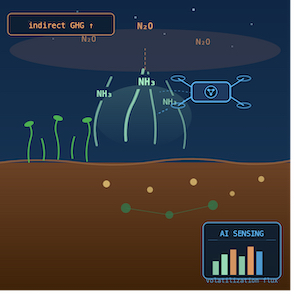
This study presents the development of a low-cost, portable, and AI-enhanced electronic nose (e-nose) system for quantifying ammonia (NH₃) volatilization from fertilized agricultural soils, with a specific emphasis on its implications for indirect greenhouse gas concentrations. Although NH₃ is not a greenhouse gas itself, its volatilization contributes significantly to indirect nitrous oxide (N₂O) emissions, one of the most potent GHGs regulated under IPCC guidelines. The proposed system integrates a MICS-6814 metal oxide sensor, ESP32 microcontroller, cloud-based data transfer, and machine learning algorithms to provide real-time monitoring and predictive analysis of NH₃ losses. Time-series sensor data were normalized, converted into area-under-the-curve (AUC) metrics, and modeled using eight machine learning algorithms. After preprocessing and hyperparameter tuning, Gradient Boosting achieved the highest performance (R² = 0.84; MAE=0.86). Laboratory evaluations demonstrated strong correlations between AUC values and NH₃-N measurements obtained through classical boric acid trapping, validating the system’s accuracy. The findings confirm that rapid detection of NH₃ volatilization can support digital nitrogen management strategies, reduce fertilizer-derived nitrogen losses, and ultimately help mitigate indirect N₂O emissions by minimizing surplus reactive nitrogen in agricultural fields. By enabling real-time emission monitoring through a low-cost digital platform, this research contributes to emerging precision agriculture solutions aimed at reducing the environmental footprint of nitrogen fertilization.
Downloads
Alfaro M, Salazar F, Hube S, Ramírez L, Mora MS, 2018. Ammonia and nitrous oxide emissions as affected by nitrification and urease inhibitors. J Soil Sci Plant Nutr 18:479–486. DOI: https://doi.org/10.4067/S0718-95162018005003202
Bremner JM, 1965. Nitrogen availability indexes – chapter 88. In: AG Norman (ed.), Methods of soil analysis. Part 2. Chemical and microbiological properties. Madison, American Society of Agronomy. DOI: https://doi.org/10.2134/agronmonogr9.2.c37
Bremner JM, Mulvaney CS, 1982. Nitrogen-total – chapter 31. In: AL Page, MR Miller, DR Keeney (eds.), Methods of soil analysis: Part 2. Chemical and microbiological properties, 9.2.2. (2nd ed.). Madison, American Society of Agronomy.
Brentrup F, Pallière B, 2011. Nitrogen use efficiency as an agro-environmental indicator. Yara International Research Centre. Available from: https://www.yara.com
Burnette E, 2010. Hello, Android: Introducing Google’s mobile development platform (3rd ed.). Flower Mound, The Pragmatic Bookshelf.
Denmead OT, 2008. Approaches to measuring fluxes of methane and nitrous oxide between landscapes and the atmosphere. Plant Soil 309:5-24. DOI: https://doi.org/10.1007/s11104-008-9599-z
Fan JC, Yang WJ, Wu MF, Liu CH, 2006. Determination and analysis of interrill erosion of a soil with coarse fragments in Thailand. T ASABE 49:1305-1314. DOI: https://doi.org/10.13031/2013.22047
Gaikwad SV, Vibhute AD, Kale KV, Mehrotra SC, 2021. An innovative IoT based system for precision farming. Comput Electron Agr 187:106291. DOI: https://doi.org/10.1016/j.compag.2021.106291
Götze H, Brokötter J, Frößl J, Kelsch A, Kukowski S, Pacholski AS, 2025. Assessment of different methods to determine NH₃ emissions from small field plots after fertilization. Environments 12:255. DOI: https://doi.org/10.3390/environments12080255
Holla S, Katti MM, 2012. Android based mobile application development and its security. Inte J Comput Trends Technol 3:486-490.
IMARC, 2024. Urea market size, share, trends and forecast by grade, application, end-use industry, and region, 2025–2033. Available from: https://www.imarcgroup.com/urea-market
Insausti M, Timmis R, Kinnersley R, Rufino MC, 2020. Advances in sensing ammonia from agricultural sources. Sci Total Environ 706:135124. DOI: https://doi.org/10.1016/j.scitotenv.2019.135124
IPCC, 2006. 2006 IPCC Guidelines for National Greenhouse Gas Inventories. Volume 4 Agriculture, Forestry and Other Land Use. Available from: https://www.ipcc-nggip.iges.or.jp/public/2006gl/vol4.html
Kacar B, 1986. [Gübreler ve gübreleme tekniği (Fertilizers and fertilization techniques)].[Book in Turkish]. Republic of Turkey Ziraat Bank Cultural Publications.
Kızıl Ü, 2006. Livestock facilities assistance program: a progress report. Dickinson Research Extension Center, North Dakota State University.
Kızıl Ü, Genç L, Rahman S, Khaitsa ML, Genc TT, 2015. Design and test of a low-cost electronic nose system for identification of Salmonella enterica in poultry manure. T ASABE 58:819-826. DOI: https://doi.org/10.13031/trans.58.11023
Kızıl Ü, Lindley JA, 2001. Comparison of different techniques in the determination of animal manure characteristics. Proc. ASAE/CSAE North Central Sections Conference, Brookings.
Klute A, 1986. Methods of soil analysis. Part 1: Physical and mineralogical methods (2nd ed.). Madison, American Society of Agronomy. DOI: https://doi.org/10.2136/sssabookser5.1.2ed
Li T, Wang C, Ji W, Wang Z, Shen W, Feng Y, Zhou M, 2023. Cutting-edge ammonia emissions monitoring technology for sustainable livestock and poultry breeding: A comprehensive review of the state of the art. J Clean Prod 428:139387. DOI: https://doi.org/10.1016/j.jclepro.2023.139387
Markom MA, Md Shakaff AY, Adom AH, Fikri NA, Khan SF, Abdullah AH, Isa, C.M.N.C. 2007. Development of low cost electronic nose. Research Report. Universiti Malaysia Perlis.
Müftüoğlu NM, Türkmen C, Çıkılı Y, 2014. [Toprak ve bitkide verimlilik analizleri (Soil and plant productivity analyses)].[Book in Turkish]. Nobel Academic Publishing.
Okur N, 2021. [Toprak bilimi ve bitki besleme (Soil science and plant nutrition)].[Book in Turkish]. Nobel Academic Publishing.
Pocatilu P, 2011. Android applications security. Info Econ 15:163-171.
Polat H, 2018. [Türkiye tarım topraklarının verimlilik özellikleri (Productivity characteristics of Turkish agricultural lands)].[Book in Turkish]. Turkish Union of Chambers of Agriculture Farmer and Village World Magazine.
Polat H, Güngör İ, Koca C, 2013. [Türkiye’de kullanılan azotlu gübrelerin standart ve yönetmeliklerle uyumluluğu üzerine bir araştırma (A study on the compliance of nitrogen fertilizers used in Turkey with standards and regulations)].[Article in Turkish]. Topraksu Dergisi 2:102-111.
Ramesh S, Vydeki D, 2019. Application of machine learning in detection of blast disease in South Indian rice crops. J Phytol 11:31-37. DOI: https://doi.org/10.25081/jp.2019.v11.5476
Redding MR, Shorten PR, Lewis R, Pratt C, Paungfoo-Lonhienne C, Hill J, 2016. Soil N availability, rather than N deposition, controls indirect N₂O emissions. Soil Biol Biochem 95:288-298. DOI: https://doi.org/10.1016/j.soilbio.2016.01.002
Rochette P, Macdonald JD, Angers DA, Chantigny MH, Gasser MO, Bertrand N, 2009. Banding of urea increased ammonia volatilization in a dry acidic soil. J Environ Qual 38:1383-1390. DOI: https://doi.org/10.2134/jeq2008.0295
Sintermann J, Spirig C, Jordan A, Kuhn U, Ammann C, Neftel A, 2012. Eddy covariance flux measurements of ammonia by high temperature chemical ionisation mass spectrometry. Atmos Meas Tech 4:599-616. DOI: https://doi.org/10.5194/amt-4-599-2011
TAGEM, 2024. [Gübre sektör politika belgesi 2023–2027 (Fertilizer industry policy document 2023-2027)].[Report in Turkish]. Ankara, General Directorate of Agricultural Research and Policies.
Terman GL, 1980. Volatilization losses of nitrogen as ammonia from surface-applied fertilizers, organic amendments, and crop residues. Adv Agron 31:189-223. DOI: https://doi.org/10.1016/S0065-2113(08)60140-6
Torello WA, Wehner DJ, Turgeon AJ, 1983. Ammonia volatilization from fertilized turfgrass stands. Agronomy J 75:454-456. DOI: https://doi.org/10.2134/agronj1983.00021962007500030009x
Wang C, Sun H, Zhang J, Zhang X, Lu L, Shi L, Zhou S, 2021. Effects of different fertilization methods on ammonia volatilization from rice paddies. J Clean Prod 295:126299. DOI: https://doi.org/10.1016/j.jclepro.2021.126299
Wang L, Chang Q, Yang J, Zhang X, Li F, 2018. Estimation of paddy rice leaf area index using machine learning methods. PLoS One 13:e0207624 . DOI: https://doi.org/10.1371/journal.pone.0207624
Wang W, Cao J, Zhang R, Chen L, Li Y, Zhang Y, 2024. Design strategies of semiconductor sensors toward ammonia monitoring in smart agriculture. J Environ Chem Eng 12:114380. DOI: https://doi.org/10.1016/j.jece.2024.114380
Yamamoto, K. 2019. Distillation of crop models to learn plant physiology theories using machine learning. PLoS One 14:e0217075. DOI: https://doi.org/10.1371/journal.pone.0217075
Yang W, Que H, Wang S, Zhu A, Zhang Y, He Y, et al., 2019. High temporal resolution measurements of ammonia emissions following different nitrogen application rates from a rice field in the Taihu Lake Region of China. Environ Pollut 257:113489. DOI: https://doi.org/10.1016/j.envpol.2019.113489
CRediT authorship contribution
Ünal Kızıl, Cafer Türkmen, conceptualization. Ünal Kızıl, Sait Can Yücebaş, experiment software. Cafer Türkmen, Yakup Çıkılı, Ali Sümer, laboratory analysis. Sait Can Yücebaş, data analysis. Ünal Kızıl, writing – original drafting. Cafer Türkmen, project administration, funding acquisition. All authors read and approved the final version of the manuscript and agreed to be accountable for all aspects of the work.
Supporting Agencies
Data Availability Statement
All data generated or analyzed during this study are included in this published article.
How to Cite

This work is licensed under a Creative Commons Attribution-NonCommercial 4.0 International License.
PAGEPress has chosen to apply the Creative Commons Attribution NonCommercial 4.0 International License (CC BY-NC 4.0) to all manuscripts to be published.