
 https://doi.org/10.4081/jae.2026.2038
Air-suction double-roller harvesting device for Lycium barbarum L.
All claims expressed in this article are solely those of the authors and do not necessarily represent those of their affiliated organizations, or those of the publisher, the editors and the reviewers. Any product that may be evaluated in this article or claim that may be made by its manufacturer is not guaranteed or endorsed by the publisher.
Accepted: 14 July 2026
Published: 19 August 2026
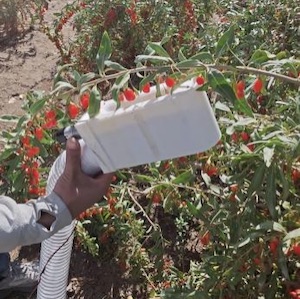
Lycium barbarum L. (L. barbarum) is a continuous-flowering and continuous-fruiting crop with thin and delicate fruit skin, necessitating multiple harvesting rounds. Currently, the harvesting of L. barbarum primarily relies on manual labor, leading to high labor demands and underscoring the urgent need for efficient, low-damage mechanized harvesting solutions. In this study, an air-suction double-roller harvesting device was designed. The harvesting mechanism operates by guiding L. barbarum into the picking zone via an airflow-induced suction stream, followed by gentle separation through a flexible double-roller structure. The fruit guiding process was modeled based on pneumatic attraction and analyzed through high-speed photography experiments. The results indicate that fruit velocity gradually increases during the guiding phase, with peak acceleration occurring at a specific location within this stage. A response-surface experiment was conducted to evaluate the effects of preloading force and roller speed on the picking rate of ripe fruit, the picking rate of unripe fruit, and the mechanical damage rate of ripe fruit. Parameter optimization resulted in optimal operating conditions with a preloading force of 0.903 N and a roller speed of 49.172 r/min. Under these conditions, validation experiments achieved a picking rate of ripe fruit of 93.7%, a picking rate of unripe fruit of 2.8%, and a damage rate of ripe fruit of 1.1%. This study provides a valuable reference for the design of vacuum-based harvesting devices for L. barbarum.
Downloads
Chen J, Zhao J, Chen Y, Bu LX, Hu GR, Zhang EY, 2019. Design and experimental optimization of vibrating-brush type wolfberry harvester. Trans Chin Soc Agric Mach 50:11.
Chen QY, Kang R, Wei NS, Fan YL, Wang ZY, Chen Y, Chen J, 2024a. Design and experiment optimize of the vibration harvesting machine of Lycium barbarum L. J Agric Eng 55:1597. DOI: https://doi.org/10.4081/jae.2024.1597
Chen QY, Zhang SX, Hu GR, Zhou JG, Zhao J, Chen Y, et al., 2022. Parameter optimization of the harvest method in the standardized hedge cultivation mode of Lycium barbarum using response surface methodology. Horticulturae 8:308.
Chen QY, Zhang SX, Wei NS, Li PH, Hu GR, Chen J, Chen Y, 2024b. Design and optimization of torsion harvester of Lycium barbarum L. Int J Agric Biol Eng 17:109-115.
Chen Y, Zhao J, Hu G, Chen J,2021. Design and testing of a pneumatic oscillating chinese wolfberry harvester. Horticulturae 7:214. DOI: https://doi.org/10.3390/horticulturae7080214
Harano Y, Ozima M, Araya K, Teramoto C, Wakita Y, Nishino T, et al., 2012. Haskaop harvester: part 3: prototypical model. Appl Eng Agric 5:15-19. DOI: https://doi.org/10.1016/S1881-8366(12)80003-6
Hou HM, Niu W, Wen QX, Yang HR, Zhang JM, Zhang R, et al., 2025. Design and testing of a pneumatic jujube harvester. Agronomy 15:1881. DOI: https://doi.org/10.3390/agronomy15081881
Jiang YW, Chen QY, Wei NS, 2025. Determining the impact bruising of goji berry using a pendulum method. Horticulturae 11:14. DOI: https://doi.org/10.3390/horticulturae11010014
Jinpeng W, Song M, Hongru X, Ying Z, Hongping Z, 2018. Research on mechanized harvesting methods of Lycium barbarum fruit. IFAC-PapersOnLine 51:223-226. DOI: https://doi.org/10.1016/j.ifacol.2018.08.148
Lu R, Dickinson N, Lammers K, Zhang K, Chu P, Li Z, 2022. Design and evaluation of end effectors for a vacuum-based robotic apple harvester. J ASABE 65:963-974. DOI: https://doi.org/10.13031/ja.14970
Ma F, Li L, Wang Y, Li P, Zhu C, 2020. Biomechanical properties of wolfberry plant organs. Eng Agric 40:162-176. DOI: https://doi.org/10.1590/1809-4430-eng.agric.v40n2p162-176/2020
Masci A, Carradori S, Casadei MA, Paolicelli P, Petralito S, Ragno R, Cesa S, 2018. Lycium barbarum polysaccharides: Extraction, purification, structural characterisation and evidence about hypoglycaemic and hypolipidaemic effects. A review. Food Chem 254:377-389. DOI: https://doi.org/10.1016/j.foodchem.2018.01.176
Patsilinakos A, Ragno R, Carradori S, Petralito S, Cesa S, 2018. Carotenoid content of Goji berries: CIELAB, HPLC-DAD analyses and quantitative correlation. Food Chem 268:49-56. DOI: https://doi.org/10.1016/j.foodchem.2018.06.013
Qingyu C, Shixia Z, Guangrui H, Jianguo Z, Jian Z, Yu C, et al., 2022. Parameter optimization of the harvest method in the standardized hedge cultivation mode of Lycium barbarum using response surface methodology. Horticulturae 8:308. DOI: https://doi.org/10.3390/horticulturae8040308
Wang RY, Zheng ZA, Xu LM, Wu G, Chen JW, Yuan QC, et al., 2019. Experimental study on parameters of pneumatic suction harvesting for Lycium barbarum. J Agric Mech Res 41:165-171.
Wang YT, Yang C, Gao YY, Lei YQ, Ma LF, Qu AL, 2024. Design and Testing of an Integrated Lycium barbarum L. harvester. Agriculture 14:1370. DOI: https://doi.org/10.3390/agriculture14081370
Wu Z, Li L, Zhao Q, Guo X, Li JJA, 2022. Design and research of a harvesting actuator for Camellia oleifera flowers during the budding period. 12:1698. DOI: https://doi.org/10.3390/agriculture12101698
Yang S, Ji J, Cai H, Chen H, 2022. Modeling and force analysis of a harvesting robot for button mushrooms. IEEE Access 10:78519-78526. DOI: https://doi.org/10.1109/ACCESS.2022.3191802
Yu ZH, Wu J, Jiang F, Xing H, Yan L, Yang JH, 2024. Kinematic analysis of the vibration harvesting process of Lycium barbarum L. fruit. Agriculture 14:1715. DOI: https://doi.org/10.3390/agriculture14101715
Zhao J, Ma T, Inagaki T, Chen Y, Hu GR, Wang ZW, et al., 2021. Parameter optimization of vibrating and comb-brushing harvesting of Lycium barbarum L. based on FEM and RSM. Horticulturae 7 286. DOI: https://doi.org/10.3390/horticulturae7090286
Zhao J, Sugirbay A, Chen Y, Zhang S, Liu FY, Bu LX, et al., 2019. FEM explicit dynamics simulation and NIR hyperspectral reflectance imaging for determination of impact bruises of Lycium barbarum L. Postharvest Biol Technol 155:102-110. DOI: https://doi.org/10.1016/j.postharvbio.2019.05.024
Zhang WQ, Li ZZ, Tan YZ, Li W, 2018. Optimal design and experiment of variable-spacing comb-brush type wolfberry harvesting device. Trans Chin Soc Agric Mach 49:83-90.
Zhang Z, Xiao HR, Ding WQ, Mei S, 2015. Simulation analysis of vibration picking mechanism for Lycium barbarum and prototype test. Trans Chin Soc Agric Eng 31:20-28.
CRediT authorship contribution
Yunlei Fan, conceptualization, data curation, methodology, validation, writing – original draft, writing – review and editing. Naishuo Wei, investigation, visualization, writing – review and editing. Zhuan Wu, investigation, visualization, writing – review and editing. Ruiqi Yao, conceptualization, software. Jie Bai, formal analysis. Zeyu Wang, formal analysis. Min Wang, writing – review and editing. Yanwu Jiang, investigation. Jun Chen, methodology, funding acquisition, writing – original draft, writing – review and editing. Yu Chen, methodology, funding acquisition, writing – original draft, writing – review and editing. Wei Zhang, supervision. All authors read and approved the final version of the manuscript and agreed to be accountable for all aspects of the work.
Supporting Agencies
Data Availability Statement
The data used to support the findings of this study are available from the corresponding author on reasonable request.
How to Cite

This work is licensed under a Creative Commons Attribution-NonCommercial 4.0 International License.
PAGEPress has chosen to apply the Creative Commons Attribution NonCommercial 4.0 International License (CC BY-NC 4.0) to all manuscripts to be published.