

 https://doi.org/10.4081/jae.2026.2030
Development and validation of a low-cost imaging system for seedling germination kinetics through time-cumulative analysis
All claims expressed in this article are solely those of the authors and do not necessarily represent those of their affiliated organizations, or those of the publisher, the editors and the reviewers. Any product that may be evaluated in this article or claim that may be made by its manufacturer is not guaranteed or endorsed by the publisher.
Accepted: 17 July 2026
Published: 29 July 2026
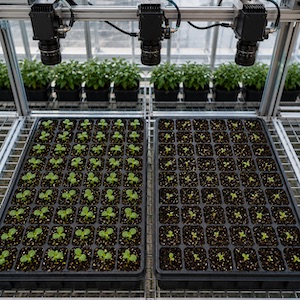
The ready-to-eat lettuce industry is rapidly expanding, increasing the need for reliable, scalable methods to assess seed germination and early growth under realistic soil conditions. This study presents an automated imaging-based approach for quantifying germination dynamics and seedling vigor using a low-cost multi-camera system under greenhouse conditions. Lettuce seeds were grown in soil either inoculated or non-inoculated with the soil-borne pathogen Rhizoctonia solani. Top-view images were acquired using commercial surveillance cameras and processed through a calibrated pipeline including geometric correction, color normalization, vegetation segmentation, clustering, and temporal tracking of emergence events. Seedling vigor was quantified through projected leaf area estimation. The proposed method enables accurate estimation of germination kinetics and growth dynamics under field-like conditions. Automated counts were validated against manual measurements at both intermediate and final time points, achieving high agreement in both cases. At the final assessment, the method reached R² = 0.98 and RMSE = 1.12, while at the midterm evaluation it achieved improved performance with R² = 0.998 and RMSE = 0.5, reflecting the lower complexity of plant structure at earlier growth stages. Results showed that pathogen inoculation significantly reduced both germination rate and seedling vigor, with up to 70% reduction in biomass accumulation. The proposed framework provides a robust, low-cost solution for high-throughput phenotyping of early plant development in soil-based systems, supporting scalable agricultural experimentation.
Downloads
Anandan A, Mahender A, Sah RP, Bose LK, Subudh, H, Meher J, et al., 2020. Non-destructive phenotyping for early seedling vigour in direct-seeded rice. Plant Methods 16:127. DOI: https://doi.org/10.1186/s13007-020-00666-6
Aydin MH, 2022. Rhizoctonia solani and Its Biological Control. Turk J Agric Res 9:118–135. DOI: https://doi.org/10.19159/tutad.1004550
Chang KF, Hwang SF, Gossen BD, Turnbull GD, Wang H, Howard RJ, 2008. Effects of inoculum density, temperature, seeding depth, seeding date and fungicidal seed treatment on the impact of Rhizoctonia solani on lentil. Can J Plant Sci 88:799–809. DOI: https://doi.org/10.4141/P06-020
Chien CF, Lin TT, 2005. Non-destructive growth measurement of selected vegetable seedlings using orthogonal images. T ASABE 48:1953–1961. DOI: https://doi.org/10.13031/2013.19987
Colmer J, O’Neill CM, Wells R, Bostrom A, Reynolds D, Websdale D, et al., 2020. SeedGerm: a cost‐effective phenotyping platform for automated seed imaging and machine‐learning based phenotypic analysis of crop seed germination. New Phytol 228:778–793. DOI: https://doi.org/10.1111/nph.16736
Daami-Remadi M, Zammouri S, El Mahjoub M, 2008. Effect of the level of seed tuber infection by Rhizoctonia solani at planting on potato growth and disease severity. Afr J Plant Sci Biotechnol 2:34-38.
da Silva MP, Tylka GL, Munkvold GP, 2017. Seed treatment effects on maize seedlings coinfected with Rhizoctonia solani and Pratylenchus penetrans. Plant Dis 101:957–963. DOI: https://doi.org/10.1094/PDIS-10-16-1417-RE
Fuentes-Peñailillo F, Carrasco Silva G, Pérez Guzmán R, Burgos I, Ewertz F, 2023. Automating seedling counts in horticulture using computer vision and AI. Horticulturae 9:1134. DOI: https://doi.org/10.3390/horticulturae9101134
Gonzalez Garcia V, Portal Onco MA, Rubio Susan V, 2006. Review. Biology and systematics of the form genus Rhizoctonia. Span J Agric Res 4:55-79. DOI: https://doi.org/10.5424/sjar/2006041-178
Gullino ML, Gilardi G, Garibaldi A, 2019. Ready-to-eat salad crops: a plant pathogen's heaven. Plant Dis 103:2153-2170. DOI: https://doi.org/10.1094/PDIS-03-19-0472-FE
Hwang SF, Ahmed HU, Turnbull GD, Gossen BD, Strelkov SE, 2014. The effect of seed size, seed treatment, seeding date and depth on Rhizoctonia seedling blight of canola. Can J Plant Sci 94:311–321. DOI: https://doi.org/10.4141/cjps2013-294
Kumar KV, Reddy MS, Kloepper J, Lawrence KS, Yellareddygari S, Zhou XG, et al., 2011. Screening and selection of elite plant growth promoting rhizobacteria (PGPR) for suppression of Rhizoctonia solani and enhancement of rice seedling vigor. J Pure Appl Microbiol 5:641-651.
Losio MN, Pavoni E, Bilei S, Bertasi B, Bove D, Capuano F, et al., 2015. Microbiological survey of raw and ready-to-eat leafy green vegetables marketed in Italy. Int J Food Microbiol 210:88-91. DOI: https://doi.org/10.1016/j.ijfoodmicro.2015.05.026
Olson E, 2011. AprilTag: A robust and flexible visual fiducial system. Proc. 2011 IEEE Int. Conf. on Robotics and Automation (ICRA), Shanghai. pp.3400-3407. DOI: https://doi.org/10.1109/ICRA.2011.5979561
Patrignani A, Ochsner TE, 2015. Canopeo: a powerful new tool for measuring fractional green canopy cover. Agron J 107:2312–2320. DOI: https://doi.org/10.2134/agronj15.0150
Raid RN, Sandoya-Miranda G, 2024. Diseases of lettuce. In: Elmer WH, McGrath M, McGovern RJ (eds.), Handbook of Vegetable and Herb Diseases. Handbook of Plant Disease Management. Cham, Springer; pp. 1-60. DOI: https://doi.org/10.1007/978-3-030-35512-8_52-1
Tomasi N, Pinton R, Dalla Costa L, Cortella G, Terzano R, Mimmo T, et al., 2015. New ‘solutions’ for floating cultivation system of ready-to-eat salad: A review. Trends Food Sci Technol 46:267-276. DOI: https://doi.org/10.1016/j.tifs.2015.08.004
Verwaaijen B, Wibberg D, Kröber M, Winkler A, Zrenner R, Bednarz H, et al., 2017. The Rhizoctonia solani AG1-IB (isolate 7/3/14) transcriptome during interaction with the host plant lettuce (Lactuca sativa L.). PLoS One 12:e0177278. DOI: https://doi.org/10.1371/journal.pone.0177278
Wareing PW, Wang Z, Coley‐Smith JR, Jeves TM, 1986. Fungal pathogens in rotted basal leaves of lettuce in Humberside and Lancashire with particular reference to Rhizoctonia solani. Plant Pathol 35:390-395. DOI: https://doi.org/10.1111/j.1365-3059.1986.tb02031.x
Zhang Z, 2000. A flexible new technique for camera calibration. IEEE Trans Pattern Anal Mach Intell 22:1330–1334. DOI: https://doi.org/10.1109/34.888718
CRediT authorship contribution
Marco Davide Michel Torrente, investigation, data curation, software, validation, writing - original draft. Alessia Follador, investigation, data curation, validation. Aldo Calcante, methodology, data curation, writing - review & editing. Paola Casati, conceptualization, resources, writing - review & editing. Roberto Oberti, Conceptualization, methodology, software, writing - review & editing.
Supporting Agencies
Data Availability Statement
Data and materials are available from the corresponding author upon request.
How to Cite

This work is licensed under a Creative Commons Attribution-NonCommercial 4.0 International License.
PAGEPress has chosen to apply the Creative Commons Attribution NonCommercial 4.0 International License (CC BY-NC 4.0) to all manuscripts to be published.