

 https://doi.org/10.4081/jae.2026.1995
Exploiting soil spectroscopy in the VNIR-SWIR range to estimate soil organic carbon stock: what role can sampling density and spacing play?
All claims expressed in this article are solely those of the authors and do not necessarily represent those of their affiliated organizations, or those of the publisher, the editors and the reviewers. Any product that may be evaluated in this article or claim that may be made by its manufacturer is not guaranteed or endorsed by the publisher.
Accepted: 19 June 2026
Published: 23 June 2026
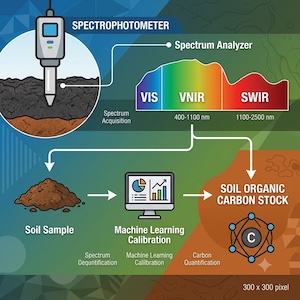
Soil organic carbon stock (SOCS) is a key indicator of soil fertility, ecosystem functioning, and climate change mitigation, yet its direct measurement remains labor-intensive, time-consuming, and costly. Visible, near-infrared, and short-wave infrared (VNIR-SWIR) soil reflectance spectroscopy offers a rapid and cost-effective alternative for SOCS estimation, although its predictive performance may strongly depend on sampling design and landscape heterogeneity. This study investigated the extent to which sampling density, spatial scale and spacing affect the accuracy of spectroscopy-based SOCS prediction. An ensemble modeling framework integrating partial least squares regression (PLSR), random forest (RF), and artificial neural networks (ANN), combined with five spectral pre-processing techniques, was applied to two contrasting datasets collected in southern Italy. The first dataset represented the entire heterogeneous region of Campania (CAM), comprising 2,957 topsoil samples collected on a sparse irregular grid with spacing ranging from 1 to 4 km. The second dataset corresponded to a local experimental field (MFC2, 8 ha), where 135 topsoil samples were collected on a dense regular grid with 25 m spacing. Model performance was evaluated using independent validation datasets through the coefficient of determination (R²), root mean square error (RMSE), and residual predictive deviation (RPD). Marked differences emerged between spatial scales. A fair predictive performance was achieved at MFC2 (best model: R² = 0.65; RPD = 1.71), whereas all models performed poorly at the regional CAM scale (best model: R² = 0.24; RPD = 1.14). Variogram analysis showed greater unresolved spatial variability (nugget effect) in the CAM dataset, indicating that the sparse regional sampling design failed to adequately capture fine-scale SOCS heterogeneity. To further investigate the role of sampling density, a denser subset of 130 CAM soil samples, with approximately 1 km spacing, was analyzed. Although model performance improved moderately (best R² = 0.35), predictive accuracy remained unsatisfactory (RPD <1.5), confirming that increased sampling density alone can be insufficient in highly heterogeneous regional landscapes. Overall, these findings demonstrate that sampling design and spatial heterogeneity are dominant factors controlling the reliability of spectroscopy-based SOCS estimation, emphasizing the adoption of spatially optimized sampling strategies to support robust regional soil carbon monitoring and assessment.
Downloads
Allocca C, Castrignanò A, Nasta P, Romano N, 2023. Regional-scale assessment of soil functions and resilience indicators: accounting for change of support to estimate primary soil properties and their uncertainty. Geoderma 431:116339. DOI: https://doi.org/10.1016/j.geoderma.2023.116339
Askari MS, O’Rourke SM, Holden NM, 2015. Evaluation of soil quality for agricultural production using visible–near-infrared spectroscopy. Geoderma 243-244:80-91. DOI: https://doi.org/10.1016/j.geoderma.2014.12.012
Barra I, Haefele SM, Sakrabani R, Kebede F, 2021. Soil spectroscopy with the use of chemometrics, machine learning and pre-processing techniques in soil diagnosis: recent advances — a review. Trends Anal Chem 135:116166. DOI: https://doi.org/10.1016/j.trac.2020.116166
Bellon-Maurel V, McBratney A, 2011. Near infrared (NIR) and mid-infrared (MIR) spectroscopic techniques for assessing the amount of carbon stock in soils: critical review and research perspectives. Soil Biol Biochem 43:1398-410. DOI: https://doi.org/10.1016/j.soilbio.2011.02.019
Ben-Dor E, Ong C, Lau IC, 2015. Reflectance measurements of soils in the laboratory: standards and protocols. Geoderma 245-246:112-124. DOI: https://doi.org/10.1016/j.geoderma.2015.01.002
Breiman L, 2001. Random forests. Mach Learn 45:5-32. DOI: https://doi.org/10.1023/A:1010933404324
Cambardella CA, Moorman TB, Novak JM, Parkin TB, Karlen DL, Turco RF, Konopka AE, 1994. Field-scale variability of soil properties in central Iowa soils. Soil Sci Soc Am J 58:1501-11. DOI: https://doi.org/10.2136/sssaj1994.03615995005800050033x
Carrascal LM, Galván I, Gordo O, 2009. Partial least squares regression as an alternative to current regression methods used in ecology. Oikos 2118:681-90. DOI: https://doi.org/10.1111/j.1600-0706.2008.16881.x
Dotto AC, Dalmolin RSD, ten Caten A, Grunwald S, 2018. A systematic study on the application of scatter-corrective and spectral-derivative preprocessing for multivariate prediction of soil organic carbon by Vis-NIR spectra. Geoderma 314:262-74. DOI: https://doi.org/10.1016/j.geoderma.2017.11.006
Francos N, Nasta P, Allocca C, Sica B, Mazzitelli C, Lazzaro U, et al., 2024. Mapping soil organic carbon stock using hyperspectral remote sensing: a case study in the Sele River plain in southern Italy. Remote Sens 16:897. DOI: https://doi.org/10.3390/rs16050897
Ge Y, Morgan CLS, Wijewardane NK, 2019. Visible and near-infrared reflectance spectroscopy analysis of soils. Soil Sci Soc Am J 84:1495-1502. DOI: https://doi.org/10.1002/saj2.20158
Haykin SS, 2009. Neural networks and learning machines. 3rd ed. London, Pearson Education.
Hermansen C, Knadel M, Moldrup P, Greve MG, Karup D, de Jonge LW, 2017. Complete soil texture is accurately predicted by visible near-infrared spectroscopy. Soil Sci Soc Am J 81:758-69. DOI: https://doi.org/10.2136/sssaj2017.02.0066
Knadel M, Thomsen A, Schelde K, Greve MH, 2015. Soil organic carbon and particle sizes mapping using vis–NIR, EC and temperature mobile sensor platform. Comput Electron Agric 114:134-144. DOI: https://doi.org/10.1016/j.compag.2015.03.013
Lang AK, Pastore MA, Walters BF, Domke GM, 2025. Bulk density calculation methods systematically alter estimates of soil organic carbon stocks in United States forests. Biogeochemistry 168:44. DOI: https://doi.org/10.1007/s10533-025-01235-6
Ludwig B, Murugan R, Parama VRR, Vohland M, 2019. Accuracy of estimating soil properties with mid-infrared spectroscopy: implications of different chemometric approaches and software packages related to calibration sample size. Soil Sci Soc Am J 83:1542-1552. DOI: https://doi.org/10.2136/sssaj2018.11.0413
Mason E, Cornu S, Arrouays D, Fantappiè M, Jones A, Götzinger S, et al., 2025. Monitoring systems of agricultural soils across Europe regarding the upcoming European soil monitoring law. Eur J Soil Sci 76:e70163. DOI: https://doi.org/10.1111/ejss.70163
Mebius LJ, 1960. A rapid method for the determination of organic carbon in soil. Anal Chim Acta 22:120-4. DOI: https://doi.org/10.1016/S0003-2670(00)88254-9
Nasta P, Bogena HR, Weuthen A, Sica B, Vereecken H, Romano N, 2020a. Integrating invasive and non-invasive monitoring sensors to detect field-scale soil hydrological behavior. Front Water 2:26. DOI: https://doi.org/10.3389/frwa.2020.00026
Nasta P, Palladino M, Sica B, Pizzolante A, Trifuoggi M, Toscanesi M, et al., 2020b. Evaluating pedotransfer functions for predicting soil bulk density using hierarchical mapping information in Campania, Italy. Geoderma Reg 21:e00267. DOI: https://doi.org/10.1016/j.geodrs.2020.e00267
Ogen Y, Zaluda J, Francos N, Goldshleger N, Bon-Dor E, 2019. Cluster-based spectral models for a robust assessment of soil properties. Geoderma 340:175-184. DOI: https://doi.org/10.1016/j.geoderma.2019.01.022
Omer E, Szlatenyi D, Csenki S, Tünde G, Chhetri G, Veres Z, Láng V, 2026. Soil health for sustainable agriculture: a bibliometric review of EU current scientific findings and research trends. Soil Adv 5:100097. DOI: https://doi.org/10.1016/j.soilad.2025.100097
Orgiazzi A, Ballabio C, Panagos P, Jones A, Fernández-Ugalde O, 2018. LUCAS soil, the largest expandable soil dataset for Europe: a review. Eur J Soil Sci 69:140-153. DOI: https://doi.org/10.1111/ejss.12499
Palladino M, Romano N, Pasolli E, Nasta P, 2022. Developing pedotransfer functions for predicting soil bulk density in Campania. Geoderma 412:115726. DOI: https://doi.org/10.1016/j.geoderma.2022.115726
Panagos P, Jones A, Lugato E, Ballabio C, 2025. A soil monitoring law for Europe. Glob Chall 9:2400336. DOI: https://doi.org/10.1002/gch2.202400336
Poeplau C, Vos C, Don A, 2017. Soil organic carbon stocks are systematically overestimated by the misuse of the parameters bulk density and rock fragment content. Soil 3:61-66. DOI: https://doi.org/10.5194/soil-3-61-2017
Romano N, Mazzitelli C, Nasta P, 2025. Root-zone water-storage capacity and uncertainty: an intrinsic factor affecting agroecosystem resilience to drought. Water Resour Res 61:e2024WR037719. DOI: https://doi.org/10.1029/2024WR037719
Romano N, Nasta P, Bogena HR, De Vita P, Stellato L, Vereecken H, 2018. Monitoring hydrological processes for land and water resources management in a Mediterranean ecosystem: the Alento River Catchment observatory. Vadose Zone J 2018;17:180042. DOI: https://doi.org/10.2136/vzj2018.03.0042
Shi L, O’Rourke S, de Santana FB, Daly K, 2023. Prediction of soil bulk density in agricultural soils using mid-infrared spectroscopy. Geoderma 434:116487. DOI: https://doi.org/10.1016/j.geoderma.2023.116487
Vasu D, Laxmanarayanan M, Tiwary P, 2026. Long-term soil organic carbon stock changes in croplands of India. Catena 268:110041. DOI: https://doi.org/10.1016/j.catena.2026.110041
Viscarra Rossel RA, 2007. Robust modelling of soil diffuse reflectance spectra by bagging-partial least squares regression. J Near Infrared Spectrosc 15:39-47. DOI: https://doi.org/10.1255/jnirs.694
Viscarra Rossel RA, Webster R, 2012. Predicting soil properties from the Australian soil visible–near infrared spectroscopic database. Eur J Soil Sci 63:848-860. DOI: https://doi.org/10.1111/j.1365-2389.2012.01495.x
Wang X, Sun H, Wang C, Liu J, Guo Z, Gao L, et al., 2024. Predicting the soil bulk density using a new spectral PTF based on intact samples. Geoderma 449:117005. DOI: https://doi.org/10.1016/j.geoderma.2024.117005
Wang Y, Yang S, Yan X, Yang S, Feng M, Xiao J, et al. 2022. Evaluation of data pre-processing and regression models for precise estimation of soil organic carbon using Vis-NIR spectroscopy. J Soils Sediments 2022;23:634-45. DOI: https://doi.org/10.1007/s11368-022-03337-2
Wold S, Sjöström M, Eriksson L, 2001. PLS-regression: a basic tool of chemometrics. Chemom Intell Lab Syst 58:109-130. DOI: https://doi.org/10.1016/S0169-7439(01)00155-1
Supporting Agencies
Data Availability Statement
The data used to support the findings of this study are available from the corresponding author on reasonable request.
How to Cite

This work is licensed under a Creative Commons Attribution-NonCommercial 4.0 International License.
PAGEPress has chosen to apply the Creative Commons Attribution NonCommercial 4.0 International License (CC BY-NC 4.0) to all manuscripts to be published.